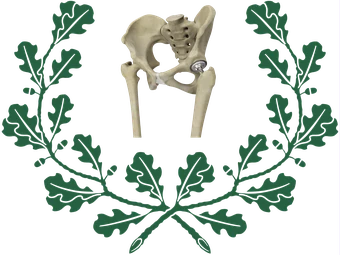
Hip Osteoarthritis (Coxarthrosis) — A Complete Guide
Author: Dr. Alexandru Grecu — Senior Orthopedic and Trauma Surgeon
Published: March 16, 2026 · Reviewed: August 21, 2026
What Is Hip Osteoarthritis?
Hip osteoarthritis (coxarthrosis) is the medical term for osteoarthritis of the hip joint. Like knee osteoarthritis, it is a degenerative condition in which the articular cartilage progressively wears away, causing pain, stiffness, and loss of mobility. The hip joint functions as a ball in a socket: the femoral head articulates with the acetabulum. It is the second most common form of osteoarthritis and significantly affects quality of life.
Causes and Risk Factors
Primary hip osteoarthritis—natural wear and tear related to age, common after 55-60 years of age.
Secondary hip osteoarthritis—caused by congenital hip dysplasia, avascular necrosis, fractures, inflammatory diseases, or femoroacetabular impingement (FAI).
Additional factors: excess body weight, genetic predisposition, activities involving repetitive stress.
Symptoms of Hip Osteoarthritis
Groin pain—the cardinal symptom. The pain is typically felt in the groin, on the front of the thigh, or even referred to the knee. For the same reason, back pain can actually come from the hip.
Stiffness—difficulty putting on shoes, cutting toenails, or getting into a car. Loss of internal rotation is one of the first signs.
Limping—a change in your gait.
Progressive limitation of activities.
Night pain—in advanced stages.
Diagnosis
Clinical examination—assessing hip mobility, testing for pain, and evaluating gait.
X-ray—an anteroposterior (AP) view of the pelvis and an axial view of the hip.
MRI—useful in early stages or for evaluating avascular necrosis.
Treatment Options
Early to moderate stages: Physical therapy, weight management, hyaluronic acid or PRP injections, and limited use of anti-inflammatory medication.
Advanced stages: Hip replacement.
An Important Warning
Hip osteoarthritis doesn't just affect the joint—it affects the whole body. A painful hip alters your posture, overstresses your knees and spine, and dramatically increases the risk of falls, especially in the elderly. Timely treatment isn't just about comfort—it's about safety.
For context, see the dedicated page on hip replacement, and if you want to go deeper, read aboutthe causes of hip pain and abouthip replacement.
Have questions or need a consultation?
Scientific References
Kellgren JH, Lawrence JS — Radiological assessment of osteo-arthrosis. Ann Rheum Dis. 1957;16(4):494-502.
For the four-stage radiological classification used in the text.
Altman R et al. — The American College of Rheumatology criteria for the classification and reporting of osteoarthritis of the hip. Arthritis Rheum. 1991;34(5):505-14.
For the clinical classification criteria: hip pain, limited internal rotation and the radiological appearance.
Fransen M et al. — Exercise for osteoarthritis of the hip. Cochrane Database Syst Rev. 2014;(4):CD007912.
For land-based therapeutic exercise, which reduces pain and improves function in hip osteoarthritis (10 randomised trials).
Bergmann G et al. — Hip contact forces and gait patterns from routine activities. J Biomech. 2001;34(7):859-71.
For the forces going through the hip during ordinary walking.
Evans JT et al. — How long does a hip replacement last? A systematic review and meta-analysis of case series and national registry reports with more than 15 years of follow-up. Lancet. 2019;393(10172):647-654.
For the lifespan of a hip replacement, based on registry data.
Katz JN et al. — Association between hospital and surgeon procedure volume and outcomes of total hip replacement in the United States medicare population. J Bone Joint Surg Am. 2001;83(11):1622-9.
For the relationship between surgeon procedure volume and outcomes — hip.
Singh JA — Smoking and outcomes after knee and hip arthroplasty: a systematic review. J Rheumatol. 2011;38(9):1824-34.
For the increased risk of complications in smokers after arthroplasty.
Allen KD, Golightly YM — State of the evidence. Curr Opin Rheumatol. 2015;27(3):276-83.
For the epidemiology of osteoarthritis.