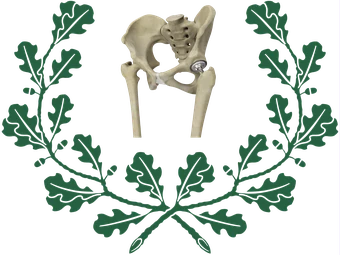
Short answer: Hip replacement is a surgery in which the damaged hip joint (femoral head and acetabulum) is replaced with an artificial implant. It is called total hip arthroplasty (THA). The most common reason for needing a replacement is hip osteoarthritis — the wear and tear of the hip cartilage. The surgery lasts 60–90 minutes, hospital stay is 4–6 days, and full recovery takes between 4 and 6 months. It has well-documented results in the literature.
Hip Anatomy and What Happens in Hip Osteoarthritis
The hip is a ball-and-socket joint. The 'ball' is the femoral head — the upper part of the femur. The 'socket' is the acetabulum — a hollow in the pelvic bone that houses the ball. Between the two, there is articular cartilage that allows for smooth, painless movement.
When this cartilage wears down — a process called hip osteoarthritis — the ball and socket rub directly bone-on-bone. This causes pain, stinging, and limited movement.
Hip osteoarthritis can be: <strong>primary (idiopathic)</strong> — age-related wear, the most common type, after age 60; <strong>secondary</strong> — occurs as a result of other conditions (insufficiently treated hip dysplasia, trauma, avascular necrosis of the femoral head, sequelae of rheumatological diseases); <strong>post-traumatic</strong> — after previous fractures or dislocations.
Indications for Hip Replacement
Besides primary hip osteoarthritis, hip replacement is also performed for: avascular necrosis of the femoral head (the femoral head loses its blood supply); adult hip dysplasia (a developmental anomaly); femoral neck fracture in elderly patients; severe rheumatological diseases (rheumatoid arthritis, ankylosing spondylitis); failure of previous interventions.
How to Recognize Hip Osteoarthritis — Signs Not to Ignore
Hip osteoarthritis does not appear suddenly. It develops insidiously, over months or years.
Early Signs (Stage I-II)
Pain in the hip or groin area (less commonly on the side); pain occurs with prolonged exertion; it subsides with rest and anti-inflammatory drugs; slightly limited mobility — putting on socks on the affected side becomes difficult. <strong>Attention:</strong> sometimes the first pain appears in the corresponding knee (referred pain) — patients see an orthopedic surgeon for their knee and discover they have hip osteoarthritis.
Moderate Signs (Stage III)
Pain occurs with normal walking, after the first 100–500 m; initial night pain; visible limp; morning hip stiffness (10–30 min to 'warm up'); inability to cut your own toenails on the affected side; limited or painful sex for partners.
Severe Signs (Stage IV) — When Replacement Becomes Necessary
Continuous pain, including at rest and at night; walking limited to 50–100 m; affected limb becomes shorter (1–2 cm); calf and gluteal muscles begin to atrophy; quality of life profoundly affected — reactive depression, social isolation; anti-inflammatory drugs no longer work or cause gastric side effects.
Patients who reach this stage usually have the same set of questions; I have gathered the frequently asked questions about hip replacement in a single article.
Before Surgery — Conservative Alternatives
Just like with the knee, we don't jump straight to surgery. There is a whole arsenal of conservative treatments that we exhaust first:
Lifestyle Modifications
Weight loss if you are overweight — every extra kilogram loads the hip (1 kg of body weight = ~4 kg of pressure per joint, Messier SP et al., JAMA 2013); adapted physical activity (swimming, cycling) — no high-impact sports; avoiding prolonged standing.
Pharmacological Treatment
Nonsteroidal anti-inflammatory drugs (NSAIDs) episodically, not chronically; paracetamol; stronger analgesics for painful episodes. Caution: prolonged use of NSAIDs damages the stomach and kidneys.
Targeted Physiotherapy
Strengthening of the gluteal and abductor muscles; stretching; hydrokinesiotherapy. Recommended with a competent physiotherapist — not 'at home from a YouTube video'.
Injections
With hyaluronic acid (effect lasts 6-12 months, medium efficacy for the hip); with PRP (platelet-rich plasma); with an anti-inflammatory steroid (rapid but short-lived effect; not to be repeated often — it damages the cartilage). → Details about PRP and hyaluronic acid injections
Less Common (with strict indications)
Corrective osteotomies for young patients with dysplasia; hip arthroscopy for labral tears or femoroacetabular impingement.
We evaluate most of these options during the consultation, depending on your stage and individual characteristics.
The Surgical Decision
Clear Indications for Replacement
Chronic pain (over 6 months) that significantly affects quality of life; insufficient response to conservative treatment; radiological images of advanced hip osteoarthritis (Tönnis II-III or Kellgren IV); significant functional loss; a patient with comorbidities compatible with surgery.
Cases Where I Recommend Postponing
Moderate hip osteoarthritis with pain controlled by medication; patient under 50 years old (we try the full conservative arsenal + possible osteotomies); BMI > 35 — we operate only after weight loss; decompensated diabetes, active infections.
Cases Where We Do NOT Postpone Anymore
Already visible limb shortening; established muscle atrophy; pathognomonic gait (Trendelenburg); compensation in the spine or other hip; progressive avascular necrosis (especially in young patients).
During the consultation, we discuss your specific situation. There is no 'one-size-fits-all' protocol.
Types of Prostheses and Surgical Approaches
Types of Prostheses
Cemented prosthesis: components are fixed with bone cement (polymethylmethacrylate); immediate, very stable fixation; recommended for patients over 70 or with osteoporosis; estimated durability 15–20 years.
Uncemented prosthesis: components have a porous surface into which the bone grows over months; 'biological' fixation; recommended for active patients under 65–70 years old, with good bone quality; estimated durability 20–25 years, sometimes more.
Hybrid prosthesis: one cemented component, one uncemented; a compromise between the two.
Bearing surface: metal-on-polyethylene (most common); ceramic-on-polyethylene (less wear); ceramic-on-ceramic (least wear; small risk of 'squeaking' noises; recommended for young patients); metal-on-metal (used less frequently now).
The decision is made individually. During the consultation, I will explain what I would specifically recommend for you and why.
Surgical Approaches
Posterior approach (Kocher-Langenbeck): the most common (60–70% of cases); excellent visibility, standardized technique; slightly longer recovery, movement restrictions for 6 weeks.
Anterolateral approach (Watson-Jones): spares the gluteal muscles; slightly faster recovery.
Direct anterior approach (DAA / Smith-Petersen): spares everything, no muscle cutting; fastest recovery, minimal restrictions; technically demanding.
I use the approach that benefits you the most, depending on your case, bone quality, and goals.
The Surgery — Step by Step
The night before: hospital admission; fasting from midnight; a mild sedative for sleep.
The morning of the surgery: preparation (antiseptic shower, change of clothes, IV line); final conversation with me + the anesthesiologist; transfer to the operating room.
In the operating room: anesthesia (usually spinal + sedation; rarely general); positioning on the side or back, depending on the approach; disinfection and sterile draping; incision (10–15 cm); exposure of the joint, dislocation of the femoral head; precise cuts to prepare the surfaces; preparation of the acetabulum and insertion of the cup; cutting the femoral head and preparing the femoral canal; insertion of the femoral components and stability check; reduction of the joint, checking mobility and limb length; copious irrigation, layered suturing.
Total duration: 60–90 minutes for standard cases.
On the first post-op day: you get out of bed, take your first steps with a walker. This is crucial — early mobilization prevents thrombosis and stiffness.
Recovery After Hip Replacement
Weeks 1–2: hospitalization for 4–6 days; walking with a walker under the supervision of a physiotherapist; regular dressing changes; anticoagulant to prevent thrombosis; strict movement restrictions (depending on the approach). Posterior: do not flex the hip over 90°, do not internally rotate, do not cross your legs. Anterior: fewer restrictions. Discharge when you can walk independently with a walker and pain is controlled orally.
Weeks 3–6: at home, physiotherapy 3–5×/week; transitioning from a walker to crutches; progressive mobility; movement restrictions still in place (especially for the posterior approach); resume driving: 6–8 weeks.
Weeks 6–12: transitioning to a cane, then walking without support; movement restrictions are relaxed after weeks 6–8; sedentary activities fully resumed; light sports (swimming, cycling) after weeks 8–10.
Months 3–6: most patients regain much of their independence; continue physiotherapy 1–2×/week for maintenance; 6-month evaluation — control X-ray + clinical exam.
Month 6+: maximum mobility (not identical to a natural hip, but very close); resumption of most activities. <strong>Allowed long-term:</strong> walking, swimming, cycling, golf, hiking, dancing, yoga, pilates. <strong>Not recommended:</strong> regular running, repetitive jumping, high-impact sports.
Practical Tips for Home
- Prepare your home in advance: raised toilet seat, support handles, remove rugs
- Ask for help during the first 1-2 weeks
- Apply ice to the area 3-4 times a day
- Do your exercises daily
Risks — Honestly, Without Hiding Them
Every surgery has risks. Hiding them doesn't help you make an informed decision. Here are the real risks, with real incidences:
| Risk | Incidence | How We Prevent It |
|---|---|---|
| Infection | 1–1.5% | Prophylactic antibiotics, strict asepsis |
| Deep Vein Thrombosis (DVT) | about 1.2% at 30 days, with prophylaxis⁷ | Anticoagulant for 4–6 weeks, mobilization |
| Pulmonary Embolism | under 1% | Same measures |
| Prosthesis Dislocation | 1–3% (more common in the first 3 months, posterior approach) | Adherence to movement restrictions |
| Limb Shortening/Lengthening | under 1 cm (usually imperceptible) | Pre-op planning, intra-op measurements |
| Sciatic Nerve Injury | under 0.5% | Careful technique |
| Prosthesis Wear/Loosening | Cumulative over time | Correct technique, normal weight |
| Residual pain | at least 14% at 6–12 months⁶ | Correct indication selection, precise technique, guided recovery |
| Need for Revision | ~3% at 10 years, ~10% at 20 years | Quality implant, follow-up |
Infection
Incidence: 1–1.5%
Prophylactic antibiotics, strict asepsis
Deep Vein Thrombosis (DVT)
Incidence: about 1.2% at 30 days, with prophylaxis⁷
Anticoagulant for 4–6 weeks, mobilization
Pulmonary Embolism
Incidence: under 1%
Same measures
Prosthesis Dislocation
Incidence: 1–3% (more common in the first 3 months, posterior approach)
Adherence to movement restrictions
Limb Shortening/Lengthening
Incidence: under 1 cm (usually imperceptible)
Pre-op planning, intra-op measurements
Sciatic Nerve Injury
Incidence: under 0.5%
Careful technique
Prosthesis Wear/Loosening
Incidence: Cumulative over time
Correct technique, normal weight
Residual pain
Incidence: at least 14% at 6–12 months⁶
Correct indication selection, precise technique, guided recovery
Need for Revision
Incidence: ~3% at 10 years, ~10% at 20 years
Quality implant, follow-up
The numbers are not meant to scare you, but to show you that the risks are small, but real. Being honest before surgery is part of your informed decision.
How the cost is covered
How a procedure is covered differs from case to case — depending on your situation and on the type of procedure. There is no generally valid answer, and this is precisely why you will not find figures or promises on this site. At the consultation, once I have seen your case, I will tell you exactly which options exist for you.
Have a question? Write to me — it is a first point of contact.
If surgery has already been proposed to you and you want to hear one more view before you decide, you can write to me — an orthopedic second opinion is a natural first step, not an affront.
Frequently Asked Questions
About Me
I am Dr. Alexandru Florian Grecu, senior consultant orthopedic surgeon, with clinical activity in Craiova. I consult and operate in Craiova. Depending on each patient's situation, some procedures may be covered by health insurance — the options are discussed at the consultation.
My main specializations are hip and knee arthroplasty, knee arthroscopy, and regenerative therapy with PRP and hyaluronic acid. In addition to my clinical work, I teach orthopedics at the University of Medicine and Pharmacy of Craiova, as a Senior Lecturer.
Orthopedics is a specialty where what matters is not just the day of the surgery, but what happens 5, 10, or 20 years later. I choose implants, techniques, and the timing of the intervention with this long-term perspective in mind. My patients are primarily people who want to regain their lost mobility — whether for work or to watch their grandchildren grow up.
For complete details about my professional background, see the About page.